The Sky Now Has a Verifiable Record
The Sky Now Has a Verifiable Record
Apr 14, 2026 / By Avalanche / 4 Minute Read
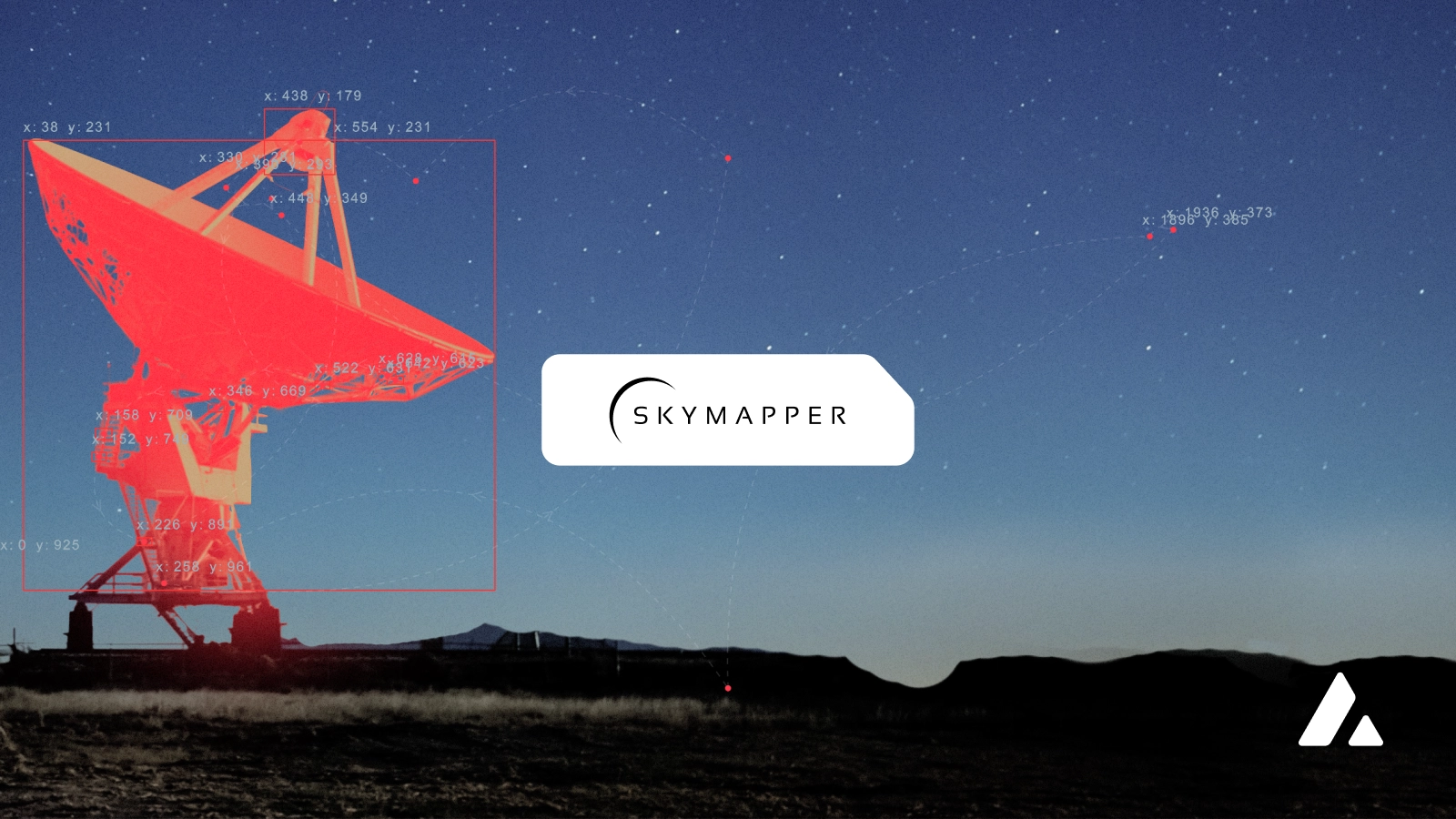
A global telescope network built on Avalanche introduces Proof of Space Observation, turning real-world sky data into verifiable, auditable records.
On a clear night, a telescope in Japan captures the faint movement of a satellite as it crosses the sky. Across the world, another instrument records a comet passing through its field of view. These moments are precise, time-sensitive, and often fleeting. They are also, in most cases, difficult to verify outside the systems that capture them.
For decades, that has been the tradeoff. Data is stored in isolated systems, shared selectively, and validated through layers of institutional trust. As activity above Earth accelerates, from satellite constellations to drone traffic to deep-space missions, those limitations are becoming harder to ignore. The sky is no longer just a scientific frontier. It is becoming critical infrastructure that requires reliable data and coordination.
SkyMapper’s launch of a dedicated Avalanche L1 starts from a different premise. An observation is not just a piece of data, but an event that should stand on its own. By anchoring telescope data on Avalanche and storing it on Akave’s decentralized, encrypted infrastructure, SkyMapper enables a system in which observations can be independently verified.
For the first time, a global telescope network is operating on decentralized infrastructure where each observation can be verified beyond the system that produced it, marking one of the first production-scale integrations of scientific research into a decentralized verification network.
From Observation to Proof
At the center of the network is what SkyMapper calls Proof of Space Observation (POSO). Each observation is signed at the source, time-stamped, and recorded onchain, creating a record that can be checked independently.
That shift changes how the data can be used. Scientific research depends on reproducibility, while defense and public-sector systems require auditability. In both cases, the question is simple: can the data hold up under scrutiny?
POSO moves that question from trust toward verification.
A Network Already in Motion
The network is already active across six continents, with around 50 participants contributing observations in real time.
There are 52 SkyBridge units deployed today, with hundreds more in production and a path toward 1,000 connected telescopes by the end of 2026, including new observatories in Nepal and Puerto Rico that will stream data directly into the L1.
The system is already operating under real conditions, capturing astronomical events and recording them on Avalanche as they happen.
Science, Integrated at the Source
The inclusion of The SETI Institute, a leading organization focused on understanding the origins and prevalence of life in the universe, brings scientific depth to the network.
Within SkyMapper, observations from SETI-affiliated stations are recorded alongside the broader network, with both raw and processed datasets stored through Akave.
This creates a shared data layer where observation requests can be coordinated, results recorded onchain, and datasets queried with a clear understanding of their origin. SETI-linked workflows now contribute to a system where scientific data can be validated beyond institutional boundaries.
Why Avalanche
SkyMapper selected Avalanche for its ability to support both permissioned and public environments within the same architecture. Sensitive or defense-related workloads can operate within a controlled L1, while open scientific participation can take place on shared infrastructure.
Smart contracts handle validation, indexing, and access, allowing observations to move through structured workflows. Combined with Akave’s decentralized storage, the system organizes and maintains data as it is produced.
A Different Kind of Infrastructure
What SkyMapper is building spans scientific research, commercial applications, and public-sector use cases such as space situational awareness. Each depends on the ability to rely on what is being observed.
By combining real-world data capture with decentralized validation and storage, SkyMapper and Avalanche create a system where each observation contributes to a broader record that can be examined and understood without relying on a single source of truth.
The sky has always been observed. What is changing is how those observations are recorded, and what can be built from them over time.
To learn more about SkyMapper, visit here.