Embedded Real World Assets (RWAs): The New Revenue Layer for Fintechs & Neobanks
Embedded Real World Assets (RWAs): The New Revenue Layer for Fintechs & Neobanks
Apr 22, 2026 / By Avalanche / 20 Minute Read
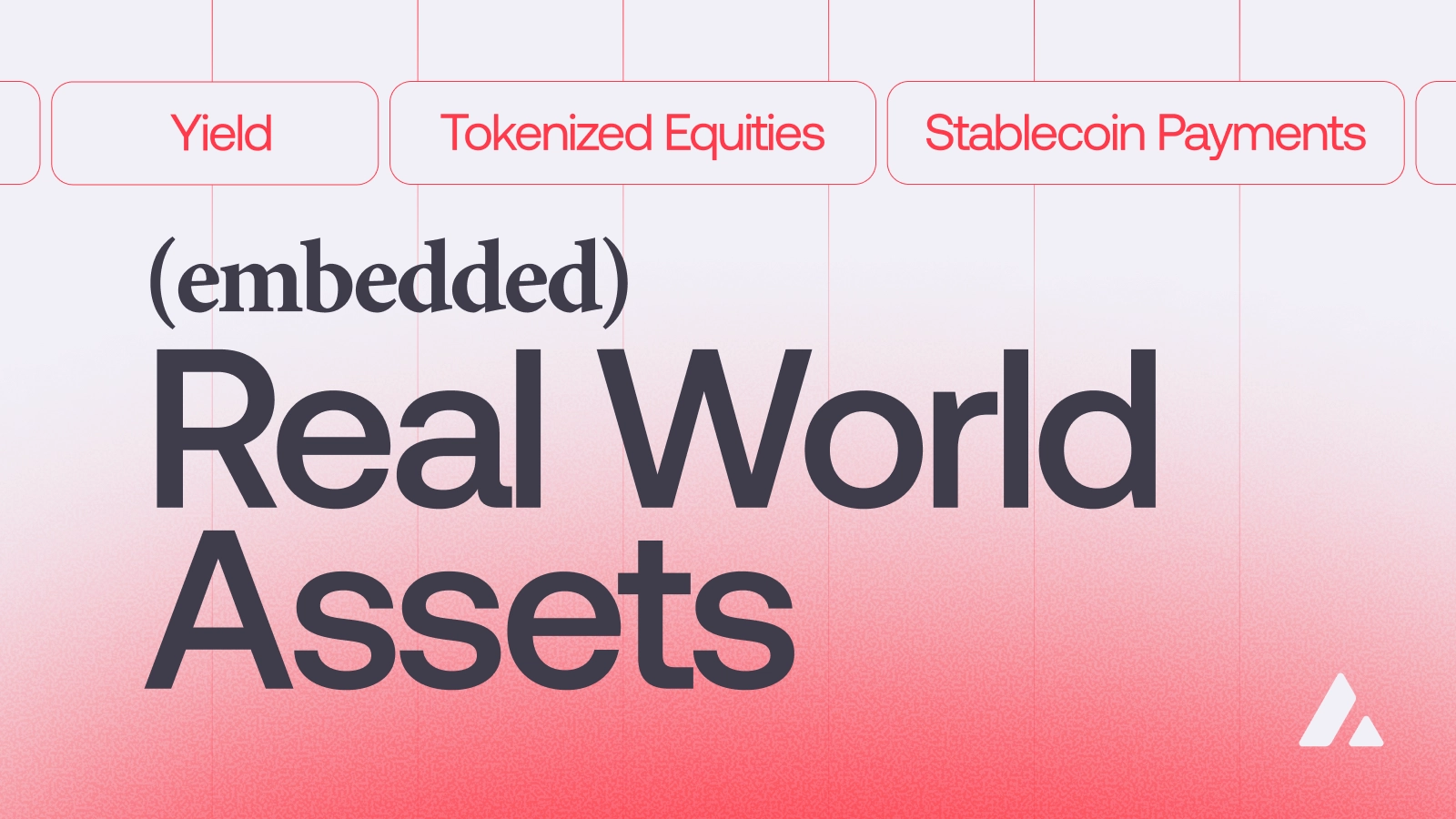
How yield infrastructure, tokenized equities, and stablecoin payment rails are unlocking new revenue streams for the next generation of financial platforms, and why Avalanche is where it's being built.
Executive Summary
The product your users want already exists. You just need to embed it.
For fintechs and neobanks serving customers across Latin America, Southeast Asia, and emerging markets globally, the opportunity has shifted. The era of competing solely on lower fees or faster onboarding is over. The platforms that win the next decade will be those that embed new financial products, yield on idle balances, access to U.S. equities, instant cross-border settlement, directly into their existing user experience.
RWAs are no longer an institutional-only story. A new generation of purpose-built infrastructure is making it possible for any fintech or neobank, regardless of balance sheet size or blockchain expertise, to offer their users products that previously required a brokerage license, a prime broker relationship, or years of regulatory negotiation.
This report documents that infrastructure, makes the revenue case, and shows, through three operating case studies, exactly how platforms are embedding RWAs today on Avalanche.
Core Thesis
Embedded RWAs are not a feature, they are a new revenue line. Fintechs and neobanks that integrate yield infrastructure, tokenized equities, and stablecoin payment rails will generate materially higher revenue per user, improve retention, and unlock institutional-grade product capabilities without institutional-grade overhead.
At a Glance
$300B+ global stablecoin supply (projected $4T by 2030)
$29.7B tokenized asset market
70–90% working capital reduction Axiym delivers vs. pre-funding
$18.9T BCG's projected tokenized RWA market size by 2033
The Opportunity
The financial products your users already want and can't get from their bank.
Users across LATAM and APAC face a common problem: their local financial system fails them in predictable ways. Currency devaluation erodes savings. Equity markets are thin or expensive to access. International transfers take days and extract an average of 5–7% in fees. Banking products offer near-zero yield on deposits. This is generally why neobanks and digital wallets have grown so rapidly in these markets. But most platforms have captured the easy gains, better UX, lower fees, mobile-first onboarding. The next growth frontier requires a different kind of product innovation: embedding financial products that generate real, recurring income for both the user and the platform.
The Three Embedded Finance Primitives
01 — Embedded Yield
Users earn competitive, RWA-backed returns on idle stablecoin balances. Platforms capture a spread. No banking license required. Powered by tokenized money market funds, U.S. Treasuries, and private credit.
02 — Tokenized Equities
Users invest in fully-backed representations of U.S. stocks, AAPL, TSLA, NVDA, SPY, from anywhere in the world. Platforms earn commissions or spreads. No brokerage build required.
03 — Capital-Efficient Payments
Stablecoin rails replace correspondent banking for cross-border flows, eliminating pre-funding requirements and unlocking 70–90% working capital efficiency gains for payment platforms and remittance operators.
Key Stats:
$4T projected stablecoin market by 2030 (Citi)
60% cheaper stablecoin remittances vs. fiat rails in Sub-Saharan Africa (Chainalysis)
$18.9T projected tokenized RWA market by 2033 (BCG)
$800M+ transaction volume through Dinari's global partner network
The Problem
Why fintechs are leaving revenue on the table.
Most fintech platforms are sitting on an underutilized asset: user funds. Every dollar a user deposits and doesn't immediately transact is a dollar that could be working, generating yield, earning commission, or powering a payment flow. Traditional banks have always monetized this float. Fintechs largely haven't.
The barriers have historically been real. Building a compliant yield product requires legal structuring, asset management relationships, custody arrangements, and regulatory navigation across multiple jurisdictions. Offering U.S. equities to a Brazilian user requires broker-dealer infrastructure and securities licensing. Running cross-border payments without pre-funding requires sophisticated credit and liquidity infrastructure.
Each of these barriers is now surmountable, not by building internally, but by embedding purpose-built infrastructure that abstracts the complexity entirely.
Build vs. Embed
Yield product on balances: Build internally = 12–24 months, legal structuring, asset manager relationships, custody, ongoing compliance. Embed via partner = API integration, weeks to launch, zero upfront cost, full white-label.
U.S. equity access: Build internally = SEC broker-dealer registration, transfer agent relationships, clearing infrastructure. Embed via partner = turnkey API, KYC handled by partner, 150+ stocks available Day 1.
Cross-border payments without pre-funding: Build internally = correspondent banking relationships, capital locked in local accounts, FX infrastructure. Embed via partner = stablecoin rails with embedded minting, real-time liquidity, 140+ currencies.
"Avalanche, as the underlying technology, is what is enabling us to move that fast, that efficiently, and that smartly." David Sutter, Co-Founder & CEO of OpenTrade
Revenue Model
What Embedded RWAs Actually Pay
The revenue model for embedded finance is straightforward: platforms may earn a spread between the yield generated by underlying assets and what they pass through to users, plus commissions on transactions and, in some cases, a share of payment infrastructure savings. The economics may be stacked meaningfully at scale.
Yield Products (e.g., OpenTrade)
A platform integrating OpenTrade can earn the spread between underlying asset yield (e.g., 4.5–5.5% on U.S. Treasuries) and what they offer users (e.g., 3.5–4.5%). For example, a $50M in user AUM, a 100bps spread generates $500K annually, with no capital at risk and no asset management overhead.
Tokenized Equities (e.g., Dinari Securities, LLC.)
Platforms earn commission on trades and can capture FX spreads for users transacting in local currency. For a neobank with 500K users across LATAM, even modest equity engagement rates (5–10%) create material transaction revenue in a product category that drives meaningful user stickiness.
Payment Infrastructure (e.g., Axiym)
For payment platforms and remittance operators, value is measured in capital released. Eliminating 70–90% of pre-funding requirements frees working capital for redeployment, while the speed improvement (T+2 to real-time) is a direct competitive differentiator in customer retention.
Revenue summary: Embedded Yield ~100–150bps spread, ~$500K–$750K per $50M AUM · Tokenized Equities per-trade revenue scaling with DAU and trade frequency · Payment Rails 70–90% working capital release, real-time vs. T+2/T+3 · Combined Stack compounding ARPU uplift, materially higher LTV per user.
The Retention Effect
A user earning yield on their balance, holding U.S. equities through your app, and using your platform for international transfers has three reasons to stay, and switching costs that compound over time. Products that generate returns build habits that fee-only products cannot.
Case Study: OpenTrade
Yield-as-a-Service · Backed by Circle & a16z · Built on Avalanche
OpenTrade is the missing infrastructure layer between the stablecoin economy and institutional-grade yield, purpose-built so fintechs and neobanks can offer their users competitive returns without becoming asset managers themselves.
Spun out of Circle and backed by a16z Crypto, Circle Ventures, and AlbionVC, OpenTrade operates a B2B2C yield-as-a-service platform. Neobanks, exchanges, and fintech platforms integrate via API and immediately gain access to a suite of white-labeled yield products, with interest accruing instantly and compounding daily. No per-transaction fees. No upfront cost. No additional KYB for companies already onboarded to Avalanche.
The legal architecture is institutional. Clients lend to a bankruptcy-remote SPV (Open Trade SPC, a Cayman Islands Segregated Portfolio Company) contractually obligated to invest exclusively in specified assets held in segregated accounts at Tier-1 institutions including JPMorgan, Barclays, Fidelity, Wilmington Trust, and Sygnum. The portfolio is managed by Five Sigma Finance, a FCA-regulated investment firm with over $6B AUM. Clients have a fully perfected security interest in the underlying collateral at all times. No securities lending or leverage is permitted.
The Three Vault Example Products
Flexible Term USDC Vault
4.10% APY. Benchmarked to Daily Treasury Bill Rates (Federal Reserve Bank of New York). Collateral is 99% Fidelity Institutional Liquidity USD Fund (AAA, 46-day tenor). Deposits and withdrawals 24/7/365, T+1 standard with T+0 available on request. No minimum. Vault token: XTBT (ERC-20), exchange rate increases daily.
Flexible Term EURC Vault
3.20% APY. Benchmarked to ECB 3-month Euro Government bond yield. Collateral is 99% Fidelity Institutional Liquidity EUR Fund (AAA). Same daily liquidity structure. Vault token: XEVT.
High Yield Corporate Bond Vault
7.00% APY. Collateral is 90%+ SHYG (BlackRock iShares 0-5 Year High Yield Corporate Bond ETF), a $6.1B fund holding over 1,000 individual bonds with a 2.90-year average duration and BB average credit rating. Short duration mitigates interest rate risk; 1,000+ holdings mitigate single-issuer default risk. Vault token: XHYC.
Key Metrics
4.10% APY on USDC Vault (T-Bill backed)
7.00% APY on High Yield Corporate Bond Vault
9.78% APY on USDC Vault with Avalanche Rewards Program
12.50% APY on High Yield Vault with Avalanche Rewards Program
The Avalanche Advantage
Companies already onboarded to Avalanche generally require no additional KYB, a meaningful friction reduction. Avalanche partners are eligible for the OpenTrade x Avalanche Rewards Program, boosting net yields substantially: up to 9.78% APY on the USDC vault, 8.20% on EURC, and 12.50% on the High Yield vault. These are yields that no traditional savings product can match in LATAM or APAC markets.
RWA vs. DeFi Yield
DeFi lending rates are volatile, the AAVE USDC pool had a 6-month range of 15.50% around a 5.50% average, demanding active management and continuous due diligence across smart contract risk, hack exposure, and key mismanagement. OpenTrade's High Yield Corporate Bond Vault delivered a 6-month average of 10.59% with a range of only 5.28%, comparable or higher returns with a fraction of the operational risk and a legal structure that banking partners can underwrite.
Bespoke Portfolios
For platforms with specific objectives, OpenTrade and Five Sigma can design custom collateral portfolios calibrated to target yield, liquidity requirements, investment volumes, and risk appetite. For example, a platform targeting 6.00% APY with investment-grade minimum ratings and majority early-withdrawal flexibility could receive a portfolio of 70% commercial paper (e.g., A2, 60-day tenor), 25% trade receivables (e.g., BBB, 30-day tenor), and 5% high yield bond ETF, e.g., 90-day term, auto-rollover, 75% early redemption available.
Case Study: Littio (LATAM)
Littio is a Colombian neobank enabling users to convert pesos into USDC for saving, transferring, and spending via mobile app. Through OpenTrade, Littio offers interest on USDC balances fully backed by U.S. Treasury Bills, with a single tap, no new onboarding. In 2024, Littio users earned 2–9% APR on USDC in their "Pots" savings product. Over $100M in volumes powered subscriptions from 300,000 users across the year. This is the exact model for a remittance platform launching savings accounts as phase one of a wallet strategy.
Case Study: Ontop (global)
Ontop is a global payroll and workforce management platform powering distributed teams across countries. Ontop processed over $1B in payroll for more than 60,000 workers, simplifying international hiring, compliance, and cross-border payments for modern companies. Ontop launched Future Fund via OpenTrade, enabling workers to earn up to 3% APR on USD balances within their Ontop Global Account. Integrated in under a month, workers automatically earn yield on paychecks while maintaining full liquidity.
Case Study: Dinari, Inc. & Dinari Securities, LLC
Tokenized U.S. Equities · SEC-Registered · Powered by Avalanche
Dinari has built what they call a "brokerage in a box", the infrastructure layer that makes it possible for any fintech or neobank to offer their users fully-backed, regulated access to U.S. equities, ETFs, and index products without navigating broker-dealer licensing, clearing relationships, or settlement complexity.
Dinari is one of the largest tokenized U.S. public securities provider, with $22.65M raised from VanEck Ventures, Hack VC, F-Prime Capital, and Blockchange Ventures. It is an SEC-registered Transfer Agent (Dinari, Inc.) and operates Dinari Securities, LLC as a SEC-registered, FINRA member Broker Dealer (CRD 329672), with Alpaca Securities as its clearing broker. This regulatory infrastructure took years to build, and partner platforms inherit it on Day 1. Over $800M in transaction volume has been processed through the partner network across 85+ countries and two dozen active API partners.
Four Products, One Network
dShares (The Mint)
250+ tokenized equities, ETFs, and yield tokens including AAPL, TSLA, NVDA, SPY, MSTR, and GOOGL. Each dShare represents the backing asset 1:1, with a direct claim on the underlying security guaranteed by Dinari Vault Ltd., no SPV or counterparty structures. Cash dividends and all corporate actions (splits, mergers, ticker changes) are fully automated. Trade execution is at NBBO (national best bid-offer) via public markets, the gold standard for U.S. brokers. Tokenization takes 2–3 weeks for public securities at ~$5K setup and $1K monthly. Issued internationally under Regulation S Safe Harbor; available in the U.S. as a secondary securities ledger with no additional registration.
Alloy Index Tokens
Portfolio tokenization engine for creating multi-asset products combining dShares, RWA tokens, and crypto assets, with automated rebalancing and NAV tracking. The flagship: S&P Digital Markets 50 (SPDM), co-launched with S&P Dow Jones Indices; 35 U.S. equity dShares plus 15 major cryptocurrencies, 24/7 trading, on-chain NAV transparency, 25bps fee. Holders maintain a direct claim on all underlying assets. Compared to Centrifuge: ~$25K to tokenize vs. ~$250K, 1–2 months vs. 3–6 months.
The Router
Compliant smart router for peer-to-peer lending, borrowing, perpetuals, and yield. Enforces KYC and jurisdictional filters before routing capital. API partners can offer margin accounts and lending without holding a lending license, Dinari's broker-dealer handles the compliance. dShares and crypto used as collateral against DeFi liquidity with no rehypothecation risk.
The DFN API
One API: trading + yield + lending + transfers
Built-in KYC, reporting, and licensing coverage
Supports both Web2 mobile apps and Web3 wallets and dApps
Key Metrics:
250+ tokenized equities, ETFs, index and yield tokens
85+ countries across two dozen active API partners
$800M+ transaction volume through partner network
2–3 weeks to tokenize public securities via The Mint
Why dShares Are Different
Dinari offers 250+ products vs. 100 from Ondo and 60 from Backed. More critically: dShare tokenholders have a direct claim on the backing asset — Ondo (BVI SPV) and Backed (Jersey SPV) use structures where the tokenholder has no direct claim. Dinari passes through cash dividends and fully automated corporate actions; neither competitor does. Execution is at NBBO via public markets rather than RFQ systems or AMMs where execution quality varies.
What API Partners Unlock
For neobanks and super apps, Lemon Cash, Fasset, and Alipay are named examples, the DFN API enables 24/7 trading of U.S. stocks without a broker-dealer license, USD+ as a high-yield savings product, and P2P lending and margin accounts without a lending license. For exchanges and custodians (e.g., Gemini, BitGo, Binance.US), it unlocks real tokenized equities, custody of dShares and Alloy tokens, and new AUM revenue streams. Flow Traders provides Day 1 liquidity support for the listing model with zero additional integration lift.
The Dinari Financial Network
In August 2025, Dinari launched the Dinari Financial Network (DFN), the first Layer 1 blockchain designed for omni-chain liquidity and settlement of tokenized securities. Built on Avalanche and powered by AvaCloud, DFN serves as the coordination and settlement layer across Arbitrum, Base, Plume, and Solana, with LayerZero integration enabling unified supply and native cross-chain transfers. The architecture positions DFN as the tokenized securities equivalent of the DTCC: institutional-grade controls operating 24/7 at sub-second finality.
"Dinari is revolutionizing global equity markets without compromising on trust or compliance. Avalanche's highly customizable architecture and institutional-grade controls enable Dinari to launch a purpose-built environment for compliant equity trading." — Morgan Krupetsky, VP Ecosystem Growth, Ava Labs
Integration Path
Register at partners.dinari.com — sandbox API access immediately, KYB process, Dinari Business Start program for companies outside the U.S.
Integrate the DFN API — trading, yield, lending, transfers, built-in KYC and compliance, supports Web2 and Web3, integrates in weeks.
Launch to your users — 250+ tokenized stocks, ETFs, and index tokens, dividends paid in stablecoins, platform earns fees and spreads, no new regulatory licenses required.
Case Study: Axiym
Real-Time Payment Liquidity · TreasuryOS · Built on Avalanche C-Chain
Axiym has solved one of the most persistent capital inefficiency problems in cross-border payments: the pre-funding trap. By acting as a real-time liquidity engine for payment platforms and MSBs, Axiym eliminates the need for capital to sit idle in accounts around the world, with Avalanche processing the settlement underneath.
Headquartered in Dubai and regulated as a Swiss financial infrastructure provider, Axiym has processed over $1 Billion in volume on Avalanche C-Chain. Its core partner, Freemarket and Lulu Financial Holdings, collectively process over $125 billion annually across 160+ countries and 80+ currencies.
The Pre-Funding Problem
Every payment company operating globally faces the same structural inefficiency: to send money to a destination country, you need to hold liquidity there in advance. A remittance platform sending payments to the Philippines, Mexico, and Nigeria simultaneously must maintain pre-funded accounts in all three — capital that is entirely idle until a payment actually occurs. This model is capital-intensive, operationally complex, and fundamentally incompatible with scaling globally without a large balance sheet. Axiym eliminates it entirely.
How TreasuryOS Works
Axiym's TreasuryOS processes the fiat → USDT → fiat flow invisibly within a payment platform's existing operations. Institutions continue to initiate payments through familiar banking APIs. Underneath, Axiym coordinates liquidity, converts funded balances into USDT settlement liquidity through an embedded minting engine, settles obligations on Avalanche C-Chain, and releases local currency through corridor-based payout partners — all in real time, without the institution touching a wallet or managing any blockchain infrastructure directly.
Key components
Compliance Module enforcing KYB, KYT, sanctions screening, and FATF Travel Rule requirements · Company Accounts tracking institutional treasury balances · Integrated USDT Minting Engine eliminating the stablecoin sandwich · FX Engine sourcing liquidity directly from local MSBs and PSPs · Adaptive Payment Engine using AI to normalize heterogeneous PSP and MSB API structures.
Key Metrics
$1B+ volume on Avalanche C-Chain
$125B/yr through Axiym's MSB partner network
140+ local currencies for USDT → fiat payout
70–90% reduction in working capital requirements vs. pre-funding
Why This Matters for Neobanks
Platforms that embed Axiym can offer real-time settlement at materially lower cost, without locking up capital in correspondent accounts. User experience improves (instant vs. 1–3 days), economics improve (lower cost per transaction), and the platform gains global reach without global pre-funding overhead.
Axiym's upcoming Trensi platform extends this further — opening its liquidity infrastructure to fintech developers, FX platforms, and onchain-native apps via programmable, API-driven FX and treasury tools.
The Network Effect
TreasuryOS becomes structurally sticky as adoption grows: institutional integrations deepen → payment flows increase → liquidity accumulates in corridors → execution improves → more institutions integrate. The network becomes progressively more valuable to participants, generating sustained recurring on-chain settlement activity tied to real economic transactions, not speculative behavior.
"Cross-border payments are one of the most capital-inefficient processes in finance today. Pre-funding has haunted MSBs since their inception. We're changing the game, unlocking capital previously trapped in pre-funding and enabling MSBs to operate in real time." — Khibar Rassul, Co-Founder & CEO, Axiym
Infrastructure
Why these products are being built on Avalanche
OpenTrade, Dinari, and Axiym made independent decisions to build on Avalanche. The architectural reasons are consistent across all three: performance, composability, and the ability to build purpose-built environments without sacrificing connectivity to the broader ecosystem.
Sub-Second Finality. Avalanche's consensus mechanism delivers deterministic, irreversible finality in under a second. A payment that can be reversed is not a payment. Probabilistic finality on Ethereum L2s is incompatible with institutional settlement standards. Avalanche's finality model is not.
Customizable Layer-1 Architecture. Dinari built an entirely new Layer 1 on Avalanche, the Dinari Financial Network, specifically designed for tokenized equity settlement. Avalanche allows sovereign, customizable chains that inherit the ecosystem's consensus engine while defining their own validator sets, permissions, and governance, without sacrificing composability.
EVM Compatibility. Full compatibility with Ethereum-native tooling, wallets, and developer infrastructure. For fintechs integrating via API, this means a mature, well-documented developer experience backed by the largest smart contract ecosystem in crypto.
Institutional Ecosystem. On Avalanche, OpenTrade, Dinari, and Axiym operate alongside BlackRock BUIDL, Franklin Templeton BENJI, Janus Henderson JAAA, Apollo ACRED, KKR's tokenized feeder fund, and J.P. Morgan's Kinexys integration. This creates regulatory legitimacy, institutional liquidity, and composability opportunities that isolated chains cannot support.
The Ecosystem Stack
Yield Layer (OpenTrade): white-labeled yield on USDC/USDT/EURC, U.S. Treasuries, MMFs, private credit, zero upfront cost, used by Littio, Belo, Buenbit, Criptan
Equity Layer (Dinari): 250+ tokenized U.S. stocks, ETFs, and index tokens, SEC-registered TA + FINRA BD, 85+ countries, $800M+ partner volume.
Payment Layer (Axiym): real-time cross-border liquidity, TreasuryOS, 140+ currencies, $1B+ on-chain volume.
The Playbook
The embedded finance playbook: how to get started
By Platform Type
Neobank with stablecoin balances → Embed yield on idle USDC/USDT. Offer users 4.10–7.00% APY (up to 12.50% with Avalanche Rewards). Earn spread. Zero upfront cost. (OpenTrade)
Digital wallet serving LATAM/APAC → Add 250+ tokenized U.S. equities, ETFs, and index tokens. Enable investing in AAPL, TSLA, SPY, and SPDM from your app. No broker-dealer license needed. (Dinari)
Remittance or payments platform → Eliminate pre-funding drag. Deploy TreasuryOS to release 70–90% of locked capital. (Axiym)
Crypto exchange or custodian → Offer RWA-backed yield vaults on idle user balances. White-label the product. (OpenTrade)
B2B fintech or payroll platform → Integrate stablecoin payment rails for cross-border payroll. Embed yield on treasury. (Axiym + OpenTrade)
The Stacking Opportunity
The most sophisticated platforms can layer all three primitives into a coherent financial services stack. A user who earns yield on their balance, invests in U.S. equities through the same app, and sends money internationally via instant stablecoin rails is no longer a transaction customer. They are a financial services customer. That distinction compounds dramatically in lifetime value.
Full Stack
(1) Foundation: USDC earns 4.10% APY (up to 9.78% with Avalanche Rewards) backed by Fidelity Institutional Liquidity USD Fund via OpenTrade. Platform earns spread. Zero upfront cost.
(2) Growth: User allocates to U.S. stocks or S&P Digital Markets 50 via Dinari dShares. KYC handled by Dinari. Dividends paid in stablecoins. No broker-dealer license required.
(3) Infrastructure: International transfers settle in seconds via Axiym stablecoin rails. No correspondent banking delay. Pre-funded capital released for redeployment.
(4) Compounding: Three active products, multiplied switching costs, materially higher ARPU and LTV.
Getting Started on Avalanche
OpenTrade — Yield Integration. Zero upfront cost, no hidden fees, revenue-share model. No additional KYB for companies already onboarded to Avalanche. Three vault products live: Flexible Term USDC Vault (4.10% APY, T-Bill backed), Flexible Term EURC Vault (3.20% APY), and High Yield Corporate Bond Vault (7.00% APY, BlackRock iShares SHYG). With the OpenTrade x Avalanche Rewards Program: up to 9.78%, 8.20%, and 12.50% respectively. Deposits and withdrawals 24/7/365, same-day settlement, no minimums. Bespoke portfolios available.
Dinari — Equity Integration. Partner program at partners.dinari.com. Sandbox API available immediately. After KYB approval, full access to 250+ tokenized U.S. stocks, ETFs, and index tokens including the S&P Digital Markets 50. One API: trading, yield, lending, and transfers with built-in KYC and compliance. No broker-dealer license required. Dinari Business Start program for companies outside the U.S.
Axiym — Payment Infrastructure. Direct engagement on payment volumes, corridors, and capital efficiency objectives. Integration abstracted from the blockchain layer — platforms operate through familiar banking APIs while TreasuryOS processes settlement underneath.
Work with Ava Labs. The Ava Labs tokenization partnerships team works directly with fintechs and neobanks across LATAM and APAC to identify the right embedded finance partners, structure co-sell opportunities, and accelerate integration timelines. Avalanche's institutional ecosystem — BlackRock, Franklin Templeton, J.P. Morgan, Apollo, and more — means your platform integrates alongside the largest names in global finance.
This report is published by Ava Labs for informational purposes. It does not constitute financial, legal, or investment advice. All data sourced from publicly available information as of Q1 2026. Revenue estimates are illustrative. Yields are subject to change without notice as decided by the provider and neither Ava Labs, Inc. nor does the Avalanche blockchain platform have any control or influence over such rates. Platform integrations are subject to each partner's onboarding requirements and applicable regulatory frameworks.
Binance Research via Business Standard (Nov 2025):