Avalanche Payments Collective: How a Payments Ecosystem Took Shape on Avalanche
Avalanche Payments Collective: How a Payments Ecosystem Took Shape on Avalanche
Jun 18, 2026 / By Avalanche / 7 Minute Read
28 organizations have joined the Avalanche Payments Collective, formalizing one of the industry's broadest payments ecosystems.
Over the past five years, Avalanche has quietly become home to one of the most expansive payment ecosystems in the industry.
The Avalanche Payments Collective launches today, bringing together Franklin Templeton, VanEck, WisdomTree, Agora, Paxos, Rain, Axiym, Ethena, Anchorage Digital, Tassat, Nonco, SETTL, zerohash, Core, OatFi, Rise, Kraken, OpenTrade, NHN KCP, Request Finance, Grove, the Wyoming Stable Token Commission, and other organizations building payment infrastructure and capabilities on Avalanche.
Franklin Templeton selected Avalanche for its tokenized money market fund. Rain built stablecoin card programs connected to Visa's global merchant network. Axiym has processed more than $1.4 billion in cross-border payment volume on the network while serving money service businesses operating across more than 150 countries.
Together, the collective's initial members support payment flows reaching more than 150 countries, 96 currencies, and approximately 22 billion payout endpoints across bank accounts, cards, and mobile wallets.
The Avalanche Payments Collective formalizes an ecosystem that spans settlement, stablecoins, treasury infrastructure, foreign exchange, asset management, compliance, and global payouts. It reflects a growing reality across financial services: payment companies need more than faster rails. They need an integrated settlement ecosystem capable of connecting liquidity, compliance, treasury workflows, and local payment networks at global scale.
The Infrastructure Behind Payments
For decades, the mechanics of moving money internationally have remained largely unchanged. Correspondent banking networks, prefunded accounts, settlement delays, and fragmented payment corridors continue to shape how capital moves through the financial system.
As stablecoins gain traction as payment and settlement assets, attention is shifting beyond the assets themselves toward the infrastructure that enables them to move through real-world financial workflows. The next phase of payment innovation will be defined by the networks, liquidity providers, settlement systems, compliance tools, and applications that help businesses move value more efficiently across markets.
"The future of global payments won't be built by a single company, product, or payment rail. It will be built by interconnected ecosystems," said John Nahas, Chief Business Officer at Ava Labs. “The Avalanche Payments Collective brings together organizations from across the payments stack with a shared vision of a more connected financial system, where money moves more efficiently, and businesses can operate globally with fewer barriers."
The organizations participating in the Avalanche Payments Collective operate across the infrastructure required to move money at scale, from settlement and liquidity to treasury management, foreign exchange, stablecoin issuance, cross-border payouts, business payments, and asset management.
Settlement and Clearing
Tassat's Lynq network represents one of the collective's institutional settlement layers.
In April 2026, Lynq migrated to a dedicated Avalanche Layer 1 (L1) while maintaining full state continuity. The network connects more than 30 participants, including Fireblocks, Galaxy, and Wintermute, and brings more than $2.5 trillion in transaction history from Tassat's banking infrastructure.
Lynq enables institutions to settle transactions in seconds rather than waiting for traditional clearing cycles, allowing liquidity to move more efficiently across counterparties and markets. SETTL, zerohash, and Dakota extend those capabilities across institutional, banking, and enterprise payment workflows, helping improve liquidity utilization, visibility into cash positions, and operational efficiency.
Anchorage provides regulated custody and banking infrastructure that supports institutions adopting stablecoin payments, digital asset settlement, and modern treasury operations.
For payment companies, Avalanche becomes a business tool rather than a technology concept. Faster settlement can support better treasury control, fewer manual reconciliation processes, more transparent payment tracking, and lower operational drag across global money movement.
Stablecoins and Digital Currency
Stablecoins are increasingly used as a settlement asset for payments, treasury operations, and cross-border transactions, enabling value to move continuously across markets rather than only during banking hours or settlement windows.
Firms such as Agora, Paxos, Ethena, and the Wyoming Stable Token Commission provide digital-dollar infrastructure supporting payment applications, financial platforms, and settlement networks operating on Avalanche. Paxos brings one of the industry's most established issuance frameworks, while the Wyoming Stable Token Commission brings public-sector stablecoin innovation through FRNT. Together, the four companies expand the pool of digital-dollar assets and liquidity available to businesses, fintechs, and financial institutions alike operating on the network.
For payment operators, the practical impact is straightforward: money moves on the same schedule as the business. Funds can settle on weekends, public holidays, and outside traditional banking hours, giving treasury teams greater flexibility in managing liquidity across markets.
Businesses can access these capabilities through existing payment and treasury workflows. Stablecoins can operate as the settlement layer in the background while customers continue to experience familiar payment and payout flows.
The ecosystem also includes infrastructure supporting transaction monitoring, sanctions screening, and Travel Rule compliance. For regulated payment companies and financial institutions, these controls must be embedded directly into payment flows rather than added later.
Cross-Border and Currency Settlement
International payments remain one of the most capital-intensive areas of financial services, with providers often maintaining prefunded balances across multiple jurisdictions to ensure obligations can be met. While reliable, this model can trap working capital and create operational complexity.
Axiym was built to address that challenge.
By providing on-demand liquidity infrastructure for licensed money service businesses, Axiym enables payment providers to continue operating via their existing banking systems and APIs while reducing reliance on prefunded balances. To date, Axiym has processed more than $1.4 billion in volume on Avalanche, while the platforms it serves collectively move more than $25 billion annually across more than 150 countries and 96 currencies.
These capabilities can be particularly valuable in corridors where settlement is slow, foreign exchange costs remain high, local payment infrastructure is fragmented, or access to dollar liquidity is constrained. In those markets, stablecoin-powered settlement can help payment companies serve customers more efficiently without rebuilding every local connection themselves.
Nonco addresses a different part of the cross-border stack. Its institutional foreign exchange venue connects more than 350 liquidity providers to stablecoin markets via a request-for-quote platform, enabling simultaneous settlement on both sides of a trade and reducing counterparty exposure associated with conventional FX workflows.
Together, these capabilities show how Avalanche can support both the movement of value and the infrastructure required to exchange, route, and settle it across currencies and jurisdictions.
Asset Management and Treasury Infrastructure
Franklin Templeton, VanEck, OpenTrade, and Grove bring treasury, liquidity, and yield-bearing financial products to the collective's asset management layer.
Among others, Franklin Templeton's BENJI fund and VanEck's VBILL are available on Avalanche, giving treasury teams access to regulated tokenized securities that remain available when settlement obligations arise.
OpenTrade provides stablecoin yield infrastructure for businesses, fintechs, and payment providers, while Grove provides institutional-grade credit and liquidity infrastructure connecting onchain capital with real-world financial markets.
As payment infrastructure becomes more digital, treasury management and settlement are becoming increasingly interconnected. Payment companies are increasingly focused not only on moving money, but also on managing liquidity across markets and making reserves more productive. Avalanche provides a common environment where these workflows can begin to converge.
Merchant Acceptance
Payment infrastructure ultimately needs to connect with real-world commerce.
NHN KCP, one of South Korea's leading payment processors, brings merchant acceptance capabilities to the collective, helping connect blockchain-based settlement infrastructure with consumer and business payment experiences.
Business Payments
B2B stablecoin payment volumes grew more than 700% year-over-year in 2025, while cross-border settlement emerged as one of the primary enterprise use cases.
OatFi, Rise, and Request Finance represent different applications of that trend. OatFi embeds financing directly into payment workflows, allowing suppliers to access funds sooner while buyers retain flexibility without requiring platforms to operate standalone lending businesses. Rise brings payroll infrastructure to the collective, extending modern settlement capabilities into workforce payments. Request Finance enables organizations to manage invoicing, accounts payable, and business payments using stablecoins, helping enterprises integrate digital assets into everyday financial operations.
Together, these companies demonstrate how payment infrastructure is expanding into financing, payroll, accounts payable, treasury operations, and liquidity management.
The Avalanche Payments Collective
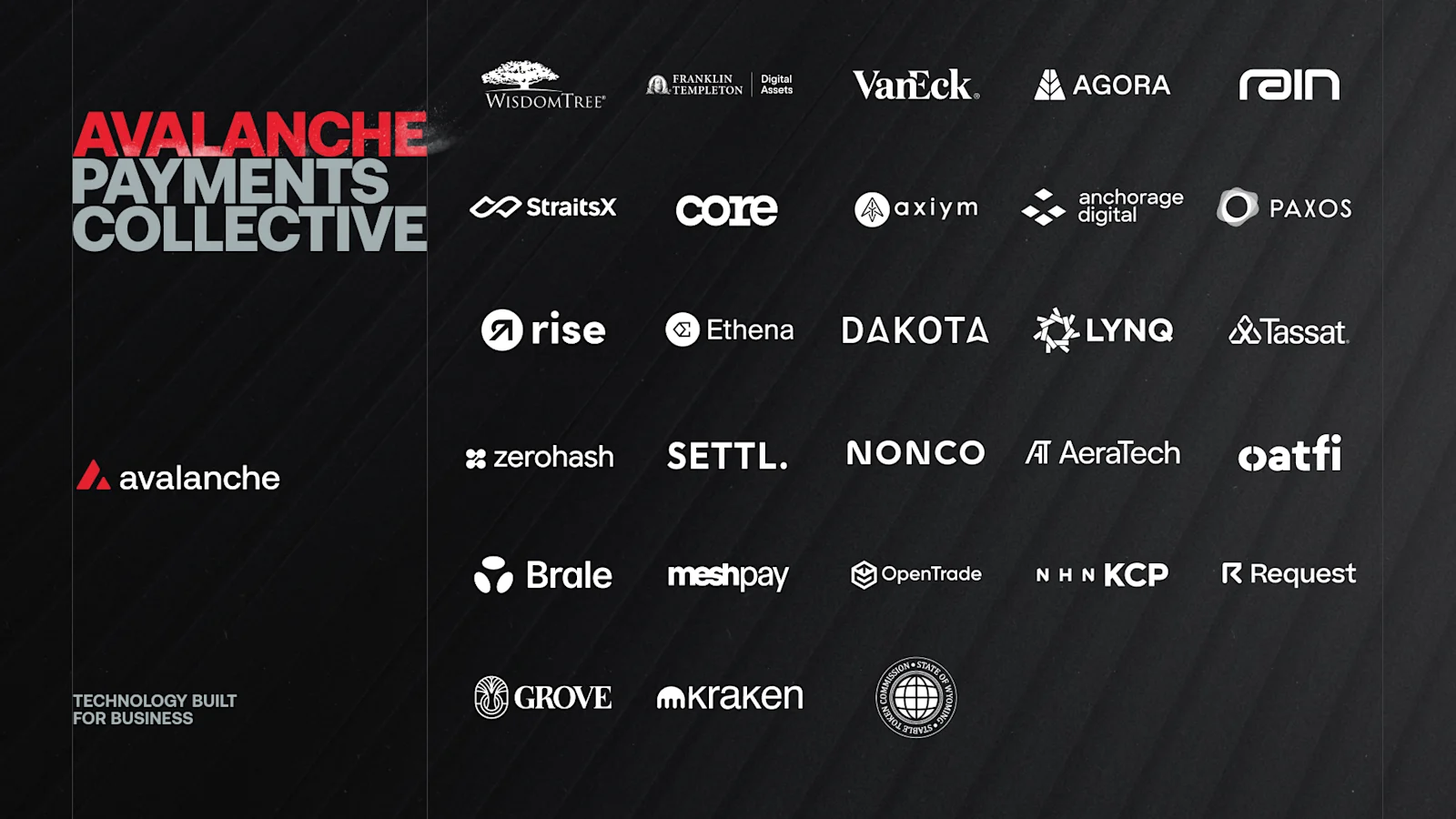
The organizations participating in the Avalanche Payments Collective span settlement, liquidity, asset management, foreign exchange, treasury infrastructure, digital-dollar issuance, merchant acceptance, business payments, and public-sector financial innovation.
The collective formalizes a network that has already emerged on Avalanche and brings together the organizations building the infrastructure underpinning the next generation of payment and settlement systems.
The collective is open to additional members. Payment companies, fintechs, and financial institutions can connect with the institutional team at avax.network/payments.