Tassat Upgrades Lynq to Avalanche, Bringing Bank-Grade Settlement Infrastructure Onchain
Tassat Upgrades Lynq to Avalanche, Bringing Bank-Grade Settlement Infrastructure Onchain
Apr 29, 2026 / By Avalanche / 4 Minute Read
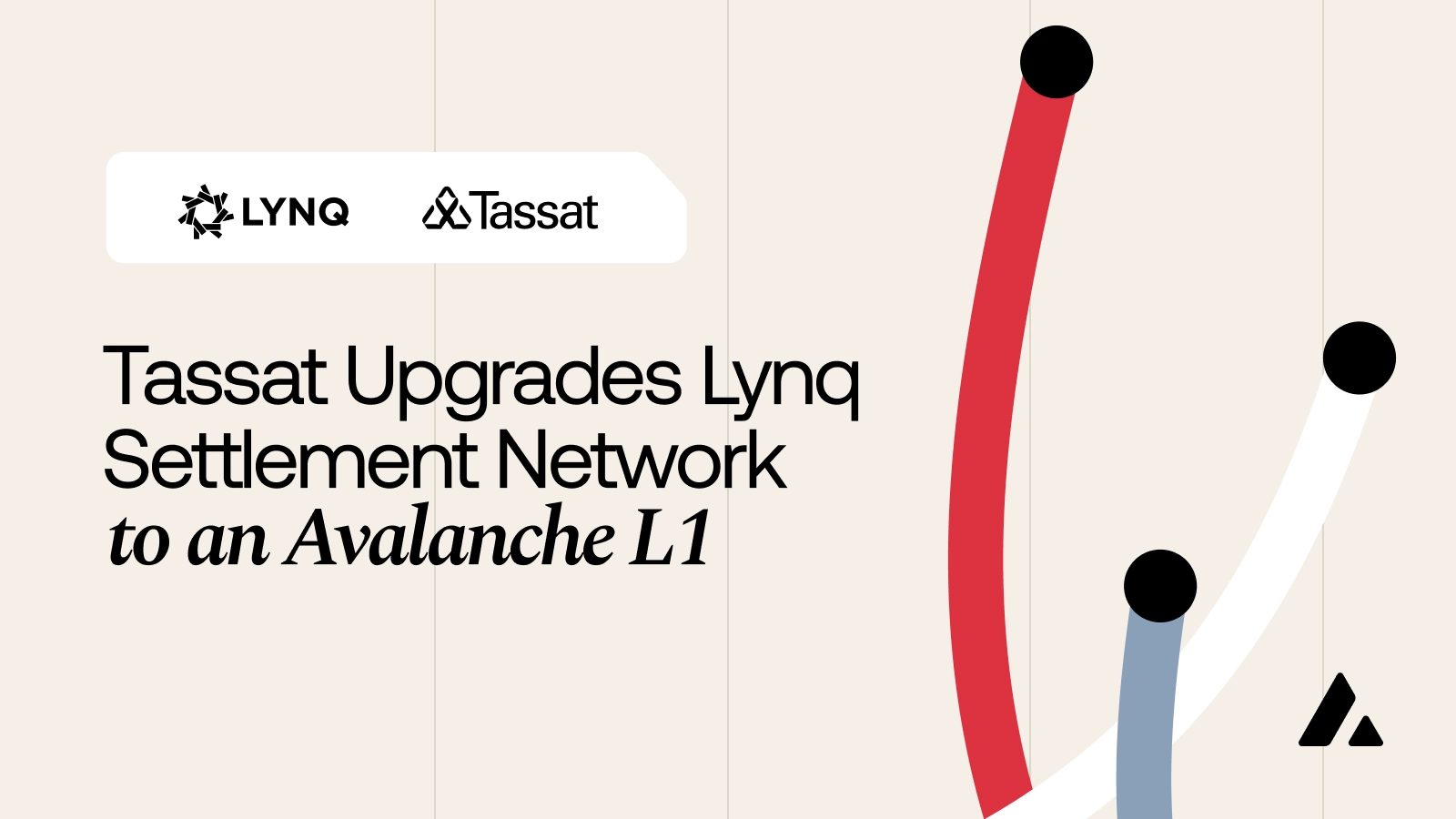
A settlement layer on Avalanche designed for real-time institutional markets.
For years, real-time settlement in financial markets has been shaped by the systems underneath it.
Banks built internal networks to move money faster. Some of those systems worked. Tassat helped power one of the most widely used examples, Signature Bank’s Signet network, which processed more than $2 trillion in transactions and showed what always-on settlement could look like in practice.
But those systems lived within closed environments. Moving capital across institutions, trading venues, and asset types still meant delays, workarounds, and idle balances sitting in the wrong place.
That’s starting to shift.
Tassat has upgraded Lynq, its real-time settlement and collateral network, to a dedicated Avalanche L1. The move extends infrastructure that has already been used at scale, with more than $2.5 trillion in transactions settled across Tassat-powered systems, into an environment designed for real-time settlement, onchain payments, and collateral mobility.
From Bank Networks to Shared Settlement Infrastructure
Lynq builds on TassatPay, a platform used across multiple U.S. banks to support real-time, tokenized payments. It allows institutions to move funds instantly, removing delays tied to clearing and settlement.
Lynq extends that model into digital asset markets. It provides a shared layer where institutions can hold and transfer dollar-equivalent assets across counterparties while continuing to earn yield. Settlement, collateral movement, and payments can all happen within the same environment, reducing the need to move capital across fragmented systems.
The network connects more than 30 institutions, including B2C2, Crypto.com, FalconX, Fireblocks, Galaxy, and Wintermute, and is already supporting live trading, collateral, and treasury workflows.
Why Avalanche
As Lynq scaled, the requirements became more precise. Real-time settlement depends on predictable performance, fast finality, and clear operational control.
Running Lynq on a dedicated, purpose-built Avalanche L1 gives Tassat control over validators, network configuration, and data access. Transactions finalize within seconds with deterministic outcomes, without relying on external settlement layers. This reduces complexity and supports workflows where timing and certainty are critical.
The architecture also allows Lynq to combine public blockchain connectivity with a controlled, permissioned environment. It remains interoperable with Avalanche’s C-Chain, enabling interaction with assets issued on the broader network, while maintaining the privacy and governance standards required by regulated institutions.
This setup also enables tighter integration with underlying platform assets, including digital securities issued natively on Avalanche.
The migration was completed with full state continuity, so existing positions, integrations, and workflows carried over without disruption. Alongside that, the upgrade delivers measurable improvements, including faster processing across complex workflows and more consistent performance during periods of higher activity.
Built for Institutional Workflows
Those improvements are already visible in production. Lynq’s yield-in-transit fund, TFND, has reached roughly $90 million in assets and has delivered over $235,000 in interest to participants. The fund accrues yield every two seconds and can be transferred peer-to-peer as a settlement asset, allowing capital to remain productive until it is used.
Lynq also supports the issuance of a registered treasury fund on Avalanche. The primary security is issued on the C-Chain, while ownership records and settlement logic are managed within a private L1, aligning regulatory requirements with more efficient operational workflows.
For Tassat, the decision to migrate came down to practical factors: performance, operational predictability, and the ability to maintain control over how the network operates.
Avalanche’s architecture maps closely to those needs. Institutions can define validator sets, configure network parameters, and manage data access, while remaining connected to a broader pool of assets and liquidity. It allows them to design settlement infrastructure on their own terms, without losing interoperability.
The upgrade of Lynq to Avalanche reflects a broader shift in how financial infrastructure is being built. Systems that once operated in isolation are starting to connect, settlement is moving closer to real time, and capital is being used more efficiently across markets.