From Static Constants to Dynamic Variables: What Three ACPs Say About Where Avalanche's Economics Are Headed
From Static Constants to Dynamic Variables: What Three ACPs Say About Where Avalanche's Economics Are Headed
Jul 2, 2026 / By Matias Antonio / 14 Minute Read
The Avalanche Foundation examines how three Avalanche Community Proposals are turning static economic parameters into adjustable tools for managing validator incentives, issuance, fees, and long-term network security.
One of the signs that an ecosystem is growing is when it starts treating constants as dynamic variables, things to be measured, debated, and adjusted on purpose rather than inherited and left alone.
Three recent Avalanche Community Proposals point in that direction. ACP-273 reduced the minimum validator staking period. ACP-283 made the C-Chain minimum gas price adjustable by validator vote. ACP-285, currently in community discussion, proposes reshaping the staking reward curve. Read one at a time, each is a parameter change. Read together, they describe a network beginning to manage its issuance and fee mechanics deliberately instead of leaving them frozen.
I want to walk through how they fit, because the interesting part is not any single number. It is the shift in posture: from inheriting an economy to searching, deliberately and in the open, for one that lasts.
How the staking reward actually works
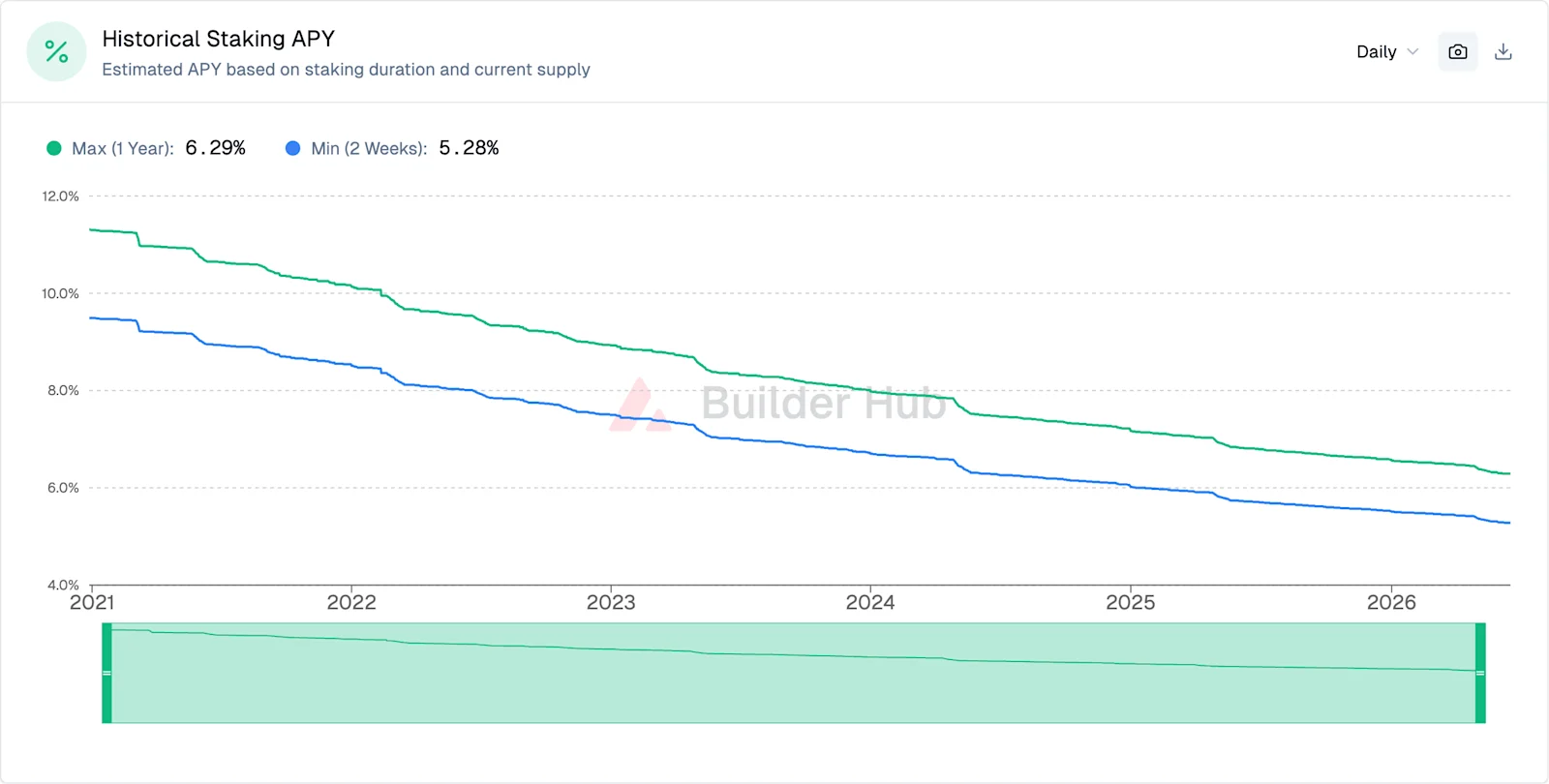
Primary Network staking rewards interpolate linearly between a floor rate and a ceiling rate, scaled by how much of the supply budget remains. A validator who commits for the shortest allowed period earns at the floor. A validator who commits for a full year earns at the ceiling. The gap between those two is the tool the protocol uses to encourage longer commitments.
One precision point that matters for anyone modeling this: the floor parameter in the code is not the reward rate a validator receives. The formula multiplies it by a remaining-supply ratio, so the effective annualized reward rate at minimum duration today sits well below the headline parameter and keeps declining as the finite supply budget is drawn down. Conflating the parameter with the realized rate is the most common way to get this analysis wrong.
What 3 ACPs Say Asset - Staking APY
Fig 1: Development of the AVAX staking reward rate for the minimum duration (2 weeks) and the maximum duration (1 year) since the network genesis. Image Source.
Why ACP-273 created a gap
ACP-273 cut the minimum validator staking period from two weeks to 48 hours. The operational case for this is strong and, for the audiences I spend most of my time with, the most immediately useful part of the package. Shorter minimum commitments lower the barrier to validating, improve capital efficiency, and make staked AVAX easier to build regulated and institutional products around: structures where redemption timing, liquid staking token mechanics, and predictable liquidity windows actually matter not just from an operational standpoint, but also from a regulatory one. The immediate, concrete version of this is an ETF issuer able to stake more of its holdings, because it no longer has to hold back as large a reserve to meet a 24-hour redemption window. Faster exit from a staking position is not a retail convenience. It is a precondition for a lot of institutional plumbing.
But there is an economic catch, and it surfaced directly in the proposal's own review. At the current reward curve, the difference in annualized reward rates between a 48-hour stake and a two-week stake is roughly three hundredths of a percentage point. That is effectively no penalty for taking on none of the duration commitment. The gap is even smaller if we consider compounding and the higher option value for longer staking duration. Pair a negligible duration premium with auto-renewal mechanics (the subject of a separate proposal, ACP-236) and the rational choice tilts toward the shortest possible lock-up that still compounds. In ACP-273 we stated the security consequence directly: if almost all stake opts for the 48-hour duration, a large share of the entities securing the network could rotate within a single day. This is an explicit risk to the stability of the network. That is why the reward curve is being revisited to capture that cost.
So ACP-273 is operationally right and, on its own, economically incomplete. It widens the door without strengthening the reason to stay inside. That is the gap ACP-285 is designed to fill, which is why I would argue the two should be read as one decision rather than two.
They are sequenced that way in practice, too. Merged is not live: ACP-273 takes effect only when a network upgrade activates it, and the intent is for that activation to land together with the reward-curve change rather than ahead of it, so the wider door and the steeper curve arrive as one package.
What ACP-285 proposes
ACP-285 lowers the floor of the reward curve while leaving the ceiling untouched. The proposal sets the floor parameter down from 10 percent to 7.5 percent and keeps the maximum where it is. That single asymmetric move does two things at once.
First, a level effect. Lower rewards at the floor mean less AVAX issued for short-duration stake, which reduces inflation. Because a significant portion of validators and delegators currently cluster two-week to one-month staking duration, near the short end of the curve, lowering the floor reaches most of the stake, and we expect the resulting reduction in inflation to land between half a point and a full point. That may not sound like much, but against current rates it is close to a 20 percent reduction. It also slows the rate at which the finite security budget, today funded entirely through inflation, is spent. That keeps issuance available as a tool for longer and gives the network more room to direct emissions toward more specific behaviors rather than paying a flat rate for minimal commitment. That last part is a design space we are still exploring, and a harder one: it carries significant engineering surface area, and it forces explicit assumptions about which behaviors are worth rewarding. So part of what we are weighing is how to turn this into a lever for experimentation rather than a one-time change.
Second, the gradient effect. Because only the floor moves, the gap between short-duration and long-duration reward rates more than doubles. In other words, it steepens the validation reward curve by pulling down the short end while leaving the long end in place. Our internal validator choice model expects this to extend average tenors by around two months. Whether or not the full extension materializes, the change manages the misalignment ACP-273 introduced: it gives validators a meaningful reason to commit for longer precisely as the network makes it easier to commit for shorter.
Two things keep this honest. First, the implementation phases the floor reduction as a linear ramp over 30 days rather than a single step, both to avoid a discontinuity that would concentrate an incentive to enter staking right before activation and create a front-running spike, and to let the ecosystem adjust in an orderly way, including the leveraged staking positions built on these rewards, rather than repricing all at once. Second, the behavioral response is a projection: the expected two-month extension is a modeled central case with real dispersion around it, and it depends on validators valuing the wider premium over liquidity, which may not hold for every cohort. Our analysis of historical staking data shows that the elasticity of stake amounts with respect to reward rate is low , which is why we expect total participation to hold at the lower floor. That, too, is in many ways an assumption: the general equilibrium outcome is not knowable in advance, and it is part of why the change phases in rather than steps. The level and budget effects hold regardless. The gradient effect is a calibrated nudge, not a guarantee.
What ACP-283 adds on the other side of the ledger
Whereas ACP-285 governs issuance and validator incentives, ACP-283 governs the supply burn.
The scalability gains that made the C-Chain cheaper and faster also came with a tradeoff: less AVAX burned per unit of activity. And cheaper, at least to me, does not seem like a meaningful edge against other chains. Trust is. That is why Ethereum keeps getting used through its gas spikes. There is a limit, of course, a point past which usage migrates, as it did during Ethereum's proof of work era, when prohibitively expensive fees drove activity elsewhere and created demand for cheaper blockspace. But up to that limit, trust dominates price. And if trust is the durable edge, it is also something a network has to earn deliberately, and there are only a few ways to earn it. How a chain manages its economics in the open, with its reasoning published and its changes phased, is one of them. That is the competition this series of changes is entered in. If cheap blockspace is not the durable edge, the network can support a minimum-fee floor that keeps the burn meaningful without giving up what actually retains users.
Mechanically, ACP-283 makes the C-Chain minimum gas price adjustable through validator voting, using the same mechanism Avalanche already established for the gas target (ACP-176) and minimum block delay (ACP-226). Today that fee floor is a static constant that can only be changed through a network upgrade. After ACP-283, it becomes a parameter the validator set can tune systematically in response to conditions, in either direction. The mechanism is direction-neutral. My read of current conditions is not: at well under a cent per transaction, today's floor neither moves the burn meaningfully nor signals anything about how the network values its own blockspace. Every serious infrastructure provider maintains a credible minimum price; compute does not clear at zero. I would argue there is room for the floor to sit higher than it does today without giving up what actually retains users. A fair question is why validators, who hold the asset the burn supports, would ever vote the floor down. Because burn is fee times activity: a floor set high enough to more accurately price usage burns less, not more, and sends the volume to chains that will take it. Validators face the same constraint the network does. The burn is only worth something if people transact. That same constraint is the bound on my own argument: the case for a higher floor holds only up to the point where it starts costing the network the usage that makes the burn worth anything.
Validator voting need not be the end state, either. Once there is enough observed response to know how the floor should move with conditions, you could imagine the formula itself shipping in the validator client, adopted by everyone who chooses to run it. I’m excited to see where the network lands. But the shape of it is worth describing: the floor would stop being a decision someone makes and become a rule everyone agreed to, expected in advance and legible to anyone building on the network. Something closer to a social contract than a setting. Discretion would be the data-gathering phase. The rule would be the destination.
That is the throughline. ACP-285 is deliberate management of issuance. ACP-283 is deliberate management of burn. In both cases the shift is from a constant somebody chose years ago to a variable the network manages on purpose.
What this adds up to
That shift, from inherited constants to dynamic variables, is the whole story. It is what it looks like for a network's economics to grow up: parameters that are measured, debated, and adjusted on purpose as conditions change, rather than chosen once and left.
The point is not any one parameter. It is the surface that opens when parameters can move at all. Once issuance and the fee floor are things the network can tune rather than inherit, they become levers for experimentation: ways to test how the system responds, to direct incentives more precisely over time, and to correct course without a hard fork each time. Getting the machinery right matters more than getting any single number perfect on the first attempt, because the machinery is what lets the numbers improve.
And there is no reason the fee floor is special. The same logic extends, in principle, to every parameter the network runs on. The reward curve could be a formula whose mechanics are public, where anyone can open a pull request proposing an improvement to how rewards are set. Inflation itself could respond to measured conditions rather than sit fixed. Even distribution is a design surface: if a fee above the burned minimum were ever shared rather than burned, how it is shared could be engineered, with resistance to concentration built in by construction rather than left to hope. I am sketching here, not announcing; none of this is proposed anywhere today. But once parameters become openly systematic, the design space stops being a list of constants and starts looking like an economy you can do engineering on.
And who is to say parameters are even the right primitive? Maybe some of these quantities should not be set at all, by vote or by formula, but discovered: run through an auction, priced by a market mechanism, left to whatever structure makes participants reveal what they actually value. I do not know, and that is the point. The function everyone in this design space is looking for, the one that maps network conditions to the right economics, is not written down anywhere. It exists only in how participants behave when conditions change, which means it can be revealed but never declared. The only way to trace it is to let the system move and watch. That, more than any single number, is what these three proposals begin to open: the ability to run the experiments that show what “right” looks like and under what conditions.
Underneath all of it is one idea about trust, and it is not a soft one. Security in proof of stake is not a feature you ship. It is a bill an attacker has to pay. To compromise the network, you have to acquire enough of the stake securing it, and that stake is denominated in the network's own token. A chain that is cheap to capture will eventually be tested. So the economic weight behind the token is not incidental to security. It is the security.
That is where it stops being abstract for a business. The cost of attacking a network is a ceiling on how much value can responsibly settle across it. No serious institution moves size onto a chain where compromising the chain costs less than the value it is moving, because at that point the attack is not a tail risk, it is a trade. As activity scales, the value at risk grows with it, and the security budget underneath has to stay credible and durable enough to keep pace, for years, not just today. That is the line from these proposals to the business case. A security budget spent with discipline rather than drawn down carelessly, a validator set with reason to stay rather than churn, a burn the network can manage rather than watch erode: these are what keep the cost of attack credible over the horizon an institution plans against. No large multinational underwrites a chain for one quarter.
These proposals and their adoption are not mine to decree: validators decide whether these changes activate and, for the fee floor, where it sits over time.
And the work is not finished, because the problem underneath it has never been solved. Long-term economic sustainability is one of the hardest open questions in this industry. No network has answered it. Not the oldest, not the largest, not us. A security budget drawn from a finite pool declines by construction, and the assumption that fee revenue arrives in time to take its place is, today, still an assumption. Every chain is running some version of this experiment; none has run long enough to declare a result. So this will not be quick, and it will not be easy, and I am not looking for a fix. I am looking for a solution that stands the test of time, and what I have laid out here is how you search for one: a first step, with the chain's other static parameters under assessment to widen the experimentation surface further; a case made in the open, not a verdict handed down; and the patience to let observed response reveal what works. That search is not a detour from the maturing I started with. It is the maturing.
Disclaimer: This article reflects the personal opinion of the author and is for general information purposes only, without representation, warranty, or guarantee of any kind.. It does not constitute technical, investment or legal advice, nor is it an offer to sell or solicitation of an offer to buy any financial instrument. The opinions reflected herein are subject to change without notice.